When families think about school safety, they want more than reassurance. They want to know that staff can account for children, recognise when something needs attention, coordinate their response and communicate clearly under pressure.
School shootings and other critical incidents are complex problems. No wristband, dashboard or single technology can guarantee prevention. A responsible safety strategy combines positive school climates, accessible ways to report concerns, multidisciplinary threat assessment, mental health support, physical security, emergency operations planning, training and cooperation with local responders.
Indoor5.0 is designed to support one important operational layer: child location visibility and accountability within equipped areas.
The operational challenge: information can quickly become outdated
Children move throughout the day from classrooms to activity areas, playgrounds, meals, transport and pickup points. During a busy transition or an emergency, a paper list or a register taken earlier in the day may not reflect the latest movement.
Staff still need clear procedures and direct supervision. Technology cannot replace either. But a well deployed system can help authorised staff access useful information without relying entirely on manual counts, radio calls or memory.
Where Indoor5.0 can help
1. Room and zone level visibility
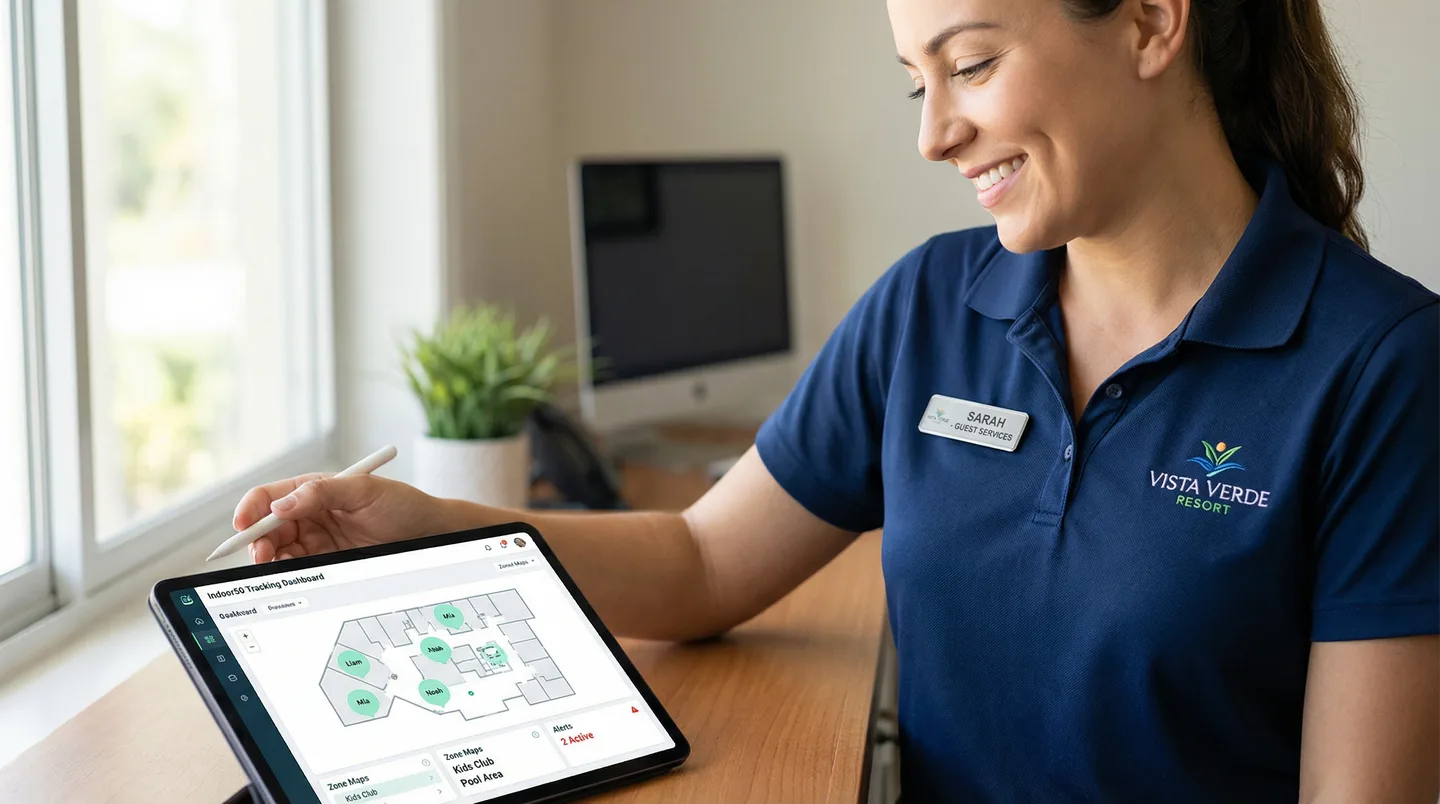
Using RFID wristbands and readers installed around a facility, Indoor5.0 can show a child’s location within covered zones on a staff dashboard. This can help staff locate children during everyday transitions and identify discrepancies that require attention.
Coverage and system design matter. Schools should understand exactly which areas are covered, how recently information is updated and what happens if a wristband, reader, network or power supply is unavailable.
2. Faster attendance reconciliation
Automated check in and check out records and zone headcounts can reduce repetitive administration and give staff a starting point for reconciling attendance. If a count does not match expectations, staff can follow their safeguarding procedure sooner.
This supports human decision making. It does not eliminate the need for staff to verify children’s welfare directly.
3. Alerts at configured boundaries
Indoor5.0 can generate an alert when a wristband approaches or crosses a configured boundary, depending on the installation. This is relevant to everyday risks such as a young child wandering towards an unauthorised exit or leaving a supervised area.
This is a boundary alert capability. It is not weapon detection, gunshot detection or a guarantee that an intruder will be stopped.
4. Clearer information for authorised staff
A shared operational picture can reduce confusion between team members. Role based access helps limit information to people who need it for their responsibilities.
During any emergency, staff must follow the school’s emergency plan and instructions from emergency responders. No one should delay evacuation, lockdown or another protective action to check a dashboard or retrieve a device.
5. Records for training and plan improvement
Attendance and movement records can help schools review everyday workflows and identify operational weaknesses, such as difficult transitions, uncovered areas or unclear staff responsibilities. These reviews can inform training and future exercises without treating technology as a complete safety solution.
The best model is layered and people first
There is no single best school model that technology can create. A stronger approach combines prevention through trusting relationships and safe reporting channels, preparedness through a site specific emergency operations plan and trained staff, physical and operational security through appropriate entry controls and supervision, and response and recovery through coordination with responders and accountable reunification procedures.
Indoor5.0 belongs in the supporting operational layer. It does not identify who may become violent, replace counselling or threat assessment, or take the place of emergency services.
Responsible implementation matters
Before deployment, a school or childcare organisation should map coverage and test the system under realistic conditions. It should establish clear staff roles and response procedures for every alert, train staff and maintain non digital backup procedures, protect children’s data through access controls and data minimisation, and explain the system clearly to staff and families without creating unrealistic expectations.
A practical contribution, not a promise of absolute safety
No responsible provider should promise to stop every threat. Indoor5.0’s contribution is more specific: helping authorised staff reduce uncertainty, account for children, manage daily movement and receive timely boundary alerts within a properly designed deployment.
Technology is most valuable when it supports prepared people and clear procedures. That is how Indoor5.0 can contribute to safer, more accountable school, childcare and after school operations, with appropriate privacy safeguards and staff training.
If your organisation is reviewing child accountability or boundary alert workflows, contact Indoor5.0 to discuss your facility, coverage requirements and a practical demonstration.
Further reading
For further guidance, review the U.S. Secret Service National Threat Assessment Center resources and the U.S. Department of Education school safety resources.
Learn more about Indoor5.0 Kids at indoor50kids.com